
B2B and B2C E-commerce With One Catalog: How to Organize It Without Duplicating Work
It often starts like this: a company has a B2C online store. Then dealers come along, so a second website is launched for them. Next comes Amazon, with a third system for managing products. A year later, the same product exists in three different places, with three descriptions and three inventory records. Every price change turns into half a day's work.
The problem isn't having multiple sales channels. It's having multiple catalogs.
Why B2B and B2C End Up on Separate Systems
Because their requirements are genuinely different. End customers want detailed product pages, photos, reviews, and credit card payments. Dealers want their own prices, product codes, fast reordering, and agreed payment terms. Many companies address these needs with two separate platforms, and that's where duplicate maintenance begins.
According to the B2B Observatory at Politecnico di Milano (October 6, 2026), 18% of large Italian B2B companies use B2B marketplaces to sell their products. Sales channels are multiplying, but the catalog should remain centralized.
What to Centralize and What to Keep Separate
Shared Across All Channels
-
Product information: SKU, name, technical attributes, and variants.
-
Product images and technical documentation.
-
Inventory levels.
-
Configurator rules, if you sell made-to-measure products.
Different for Each Channel
-
Pricing: public price lists, dealer-specific price lists, and marketplace prices.
-
Visibility: some products are available exclusively to B2B customers, others exclusively to B2C customers.
-
Content: product descriptions for consumers and technical buyers can differ.
-
Payment methods and shipping options.
When a platform separates these two levels, adding a new sales channel means defining prices and product visibility rather than uploading the entire catalog again.
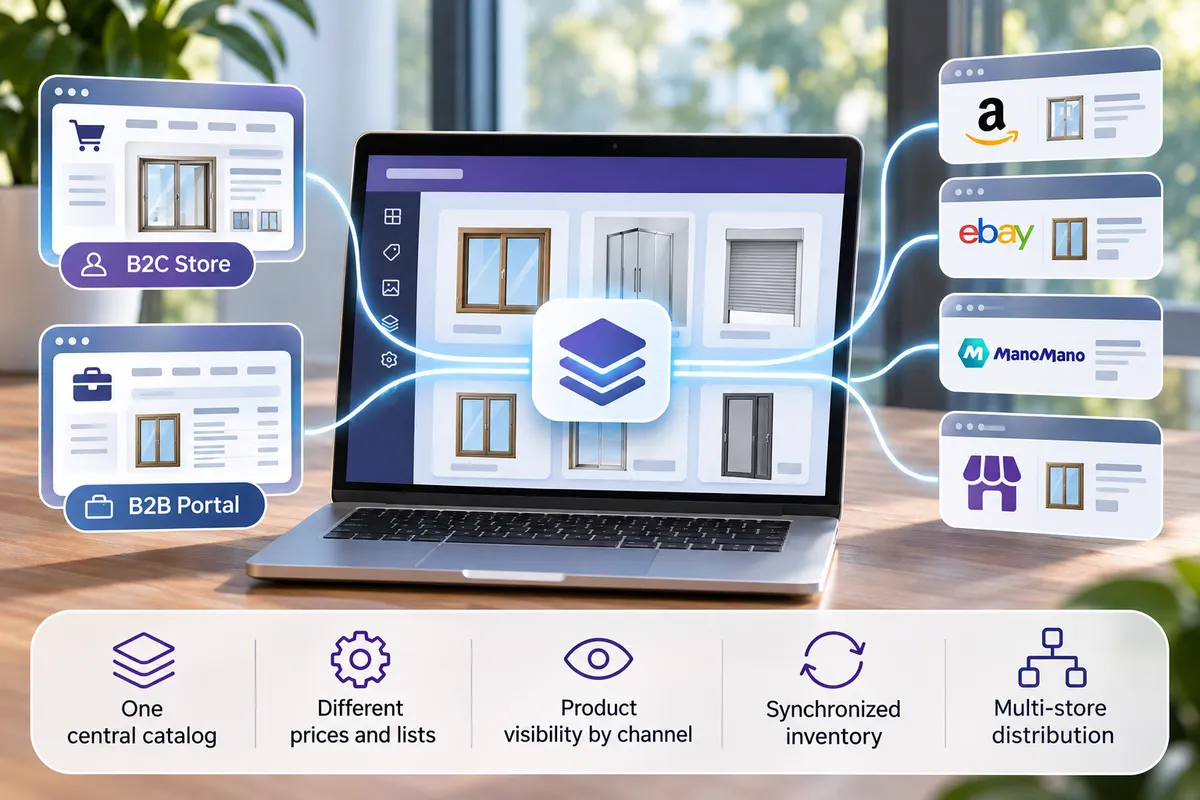
Four Destinations, One Catalog
B2C Store
Your consumer-facing online store, with the features described on the B2C E-commerce page.
B2B Portal
The same catalog, with price lists for individual customers, groups, or categories, prices visible exclusively to registered and verified customers, fast reordering, and sales agent tools (B2B E-commerce).
Amazon, eBay, and ManoMano
As described on the Amazon & eBay page, you can upload products, synchronize prices and inventory, and receive orders without leaving your store.
According to the pricing page, the Amazon connector costs €25/month, with a 0% commission on up to 150 orders and 0.3% on additional orders. The same page mentions integrations with Amazon, eBay, and ManoMano.
[need: pricing for eBay and ManoMano connectors. On the pricing page, all three entries are labeled "Amazon connector Service"]
Industry-Specific Marketplaces
With Markeplay Connect, products can also be distributed through marketplaces within the ecosystem, such as Infissifaidate.it for windows and doors.
Markeplay provides native multi-store distribution through a centralized catalog, allowing you to publish and update content across all your stores instantly.
How Different Platforms Approach Multi-Store Management
| Platform | Multiple Stores From One Catalog | Source |
|---|---|---|
| BigCommerce | Additional stores at an extra cost: $30/month (up to 3) on Core, $50/month (up to 5) on Growth, and $100/month (up to 8) on Scale. | bigcommerce.com/pricing, accessed October 19, 2026 (Market Researcher) |
| Shopify | Free expansion stores are included exclusively with Plus. Marketplace sales are managed through the Marketplace Connect app (1% up to $99/month after 50 orders). | shopify.com/pricing and /channels, accessed October 8, 2026 (Market Researcher) |
| PrestaShop | Native multistore functionality. | prestashop.it/scopri-prestashop, accessed October 12, 2026 (Market Researcher) |
| Markeplay | Multi-store distribution from a centralized catalog. Amazon and eBay managed from the same dashboard. | markeplay.com, homepage and Amazon & eBay page, accessed October 9, 2026 |
These platforms take different approaches. What matters is finding the one that fits your number of stores and pricing structures.
The Airlite Case Study
Airlite, a manufacturer of natural paints, launched its online store, shop.airlite.com, with Markeplay alongside its corporate website.
The March 31, 2025 announcement describes the project as currently focused on B2C, with a strategic vision to expand toward professionals, architects, and dealers.
This follows the approach described in this article: start with one channel while keeping the catalog ready for the next.
Questions to Ask Before Choosing a Platform
-
If I change a public price, what happens to my dealers' price lists?
-
Can I make a product visible exclusively to B2B customers?
-
Is inventory synchronized across the online store, B2B portal, and marketplaces?
-
How much does each additional store cost, and how many are included in the plan?
-
Does the product configurator work across all channels or just one?
Frequently Asked Questions
Can B2B and B2C operate on the same e-commerce platform?
Yes. You can maintain one catalog with different prices and product visibility based on customer type, or run separate stores that share the same catalog.
Is it better to have one store or two separate stores?
It depends on how different the customer experiences need to be. If dealers require an interface focused on fast reordering, a dedicated store is often easier to work with. What matters is keeping the catalog centralized.
How do I synchronize products and inventory with Amazon and eBay?
Through a connector that uploads products, synchronizes prices and inventory, and imports orders.
In Markeplay, the Amazon connector costs €25/month, with a 0% commission on the first 150 orders and 0.3% on additional orders.
How much does it cost to manage multiple stores?
Costs vary significantly. See the comparison table above for pricing details and sources. Markeplay plans start at €97/month.
Try It With Your Own Product Catalog
-
Request a demo → https://www.markeplay.com/it/contactus
-
Start your 30-day free trial → https://backoffice.markeplay.com/register?utm_source=blog&utm_medium=article&utm_campaign=ecommerce-b2b-e-b2c-un-catalogo-piu-store&utm_content=cta
-
"Plugin-Free B2B E-commerce" Checklist → https://www.markeplay.com/it/info/checklist-ecommerce-b2b?utm_source=blog&utm_medium=article&utm_campaign=ecommerce-b2b-e-b2c-un-catalogo-piu-store&utm_content=checklist
Sources
-
B2B Digital Commerce & Experience Observatory, Politecnico di Milano, press release dated October 6, 2026: https://www.osservatori.net/comunicato/b2b-digital-commerce-experience/b2b-digital-commerce-italia/ (accessed October 19, 2026): 18% B2B marketplace adoption.
-
BigCommerce, pricing page: https://www.bigcommerce.com/pricing/ (accessed October 19, 2026, Market Researcher).
-
Shopify, https://www.shopify.com/pricing and https://www.shopify.com/channels (accessed October 8, 2026, Market Researcher).
-
PrestaShop, https://prestashop.it/scopri-prestashop/ (accessed October 12, 2026, Market Researcher).
-
Markeplay, homepage, B2B E-commerce, B2C E-commerce, Amazon & eBay, Markeplay Connect, and licensing plans (accessed October 9, 2026). Airlite announcement dated March 31, 2025: https://www.markeplay.com/it/news/2025-03-31/markeplay-rivoluziona-l-e-commerce-di-airlite-con-il-lancio-di-shop-airlite-com-NOC9EW03E-post.