
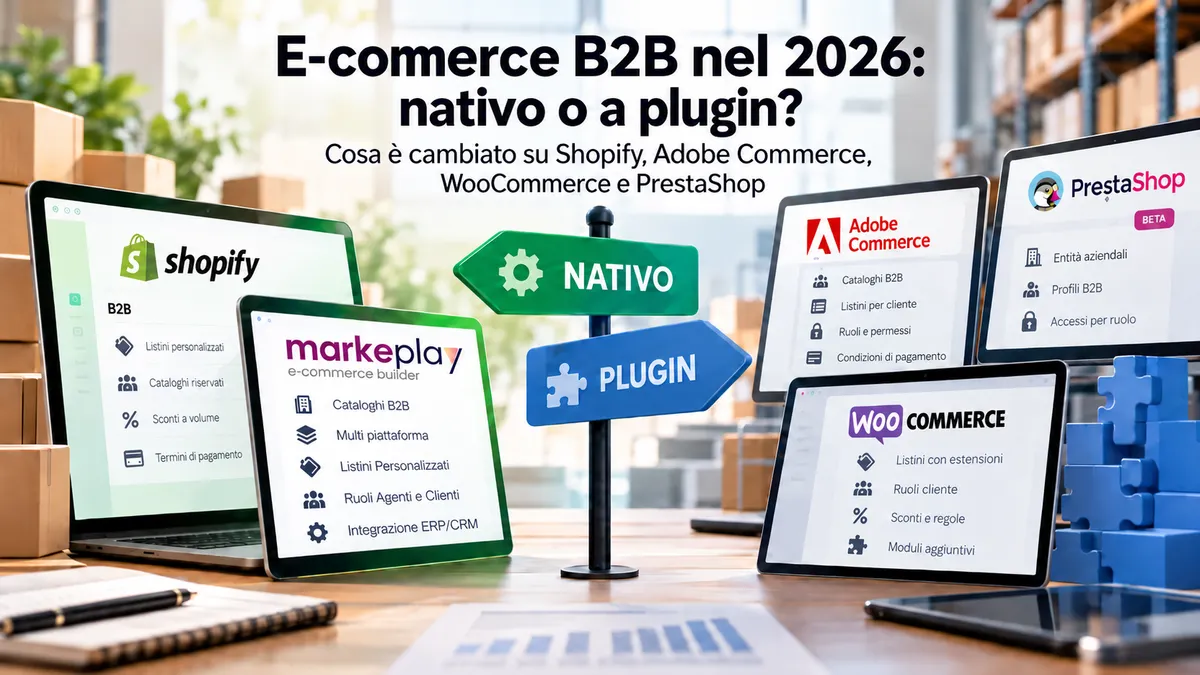
B2B ecommerce in 2026: native features or plugins? What changed on Shopify, Adobe Commerce, WooCommerce and PrestaShop
In the past six months, the main ecommerce platforms made decisions that directly affect anyone selling B2B:
- in April 2026, Shopify extended native B2B features to every plan;
- on 30 September 2026, PrestaShop released version 9.2, with a new B2B foundation still in beta;
- on 11 August 2026, standard support for Adobe Commerce 2.4.6 ended.
Underneath all three sits the same question: should B2B features such as customer price lists, private catalogues and payment terms live in the core of the platform, or can they be added through extensions? This article lines up the facts, with each platform's official sources, and a list of questions to help you choose.
What changed, platform by platform
Shopify: native B2B on every plan
On 2 April 2026, Shopify announced that its foundational B2B features were coming to the Basic, Grow and Advanced plans "at no extra cost": company profiles for wholesale buyers, up to three custom catalogues with tailored pricing, volume discounts and quantity rules, vaulted credit cards and payment terms. Plus keeps unlimited catalogues for customer-specific pricing, direct catalogue assignment to companies and locations, partial payments and deposits. Shopify says it built B2B "directly into the core of our platform, not as a bolt-on".
What it means: even the largest ecommerce SaaS treats B2B as a core feature, not a separate app.
PrestaShop 9.2: a new B2B foundation, in beta
PrestaShop 9.2, released on 30 September 2026, adds a native one page checkout, the Ask AI assistant in the back office and Extra Properties. On B2B, the developer documentation says the release "lays the foundation for an improved B2B mode": business entities, B2B customer profiles, business identifiers, B2B addresses and role-based access. It sits behind the improved_b2b feature flag, in beta and disabled by default, and PrestaShop itself writes: "We do not recommend building on it yet".
What it means: the direction is the same (B2B in the core), but PrestaShop merchants running B2B in production still rely on modules today.
Adobe Commerce (Magento): the upgrade calendar
Adobe's policy (updated 18 September 2026) gives each release three years of standard support from general availability. For 2.4.6, standard support ended on 11 August 2026, extended support ends on 31 August 2027 and the security-only period on 31 May 2028. Version 2.4.9 has been available since 12 May 2026. For Adobe Commerce on Cloud, from 1 June 2027 Adobe will no longer maintain environments running unsupported versions. The same page notes that PHP 8.2, used by some 2.4.6 installations, reaches end of life on 31 December 2026, with PCI compliance implications.
What it means: Adobe Commerce remains a highly configurable platform with dedicated B2B features. The price of that freedom is an upgrade calendar the business, or its agency, has to plan for.
WooCommerce: B2B through extensions
On WooCommerce, B2B features are usually added through extensions from the official marketplace. Two examples read on woocommerce.com on 9 October 2026: Extend B2B – Price List (Codup), for price lists assigned to customers, roles or locations, at $29 a year; B2B & Wholesale Suite (WebWizards), which says it integrates "20 separate plugin modules", at $149 a year.
What it means: WooCommerce lets you pick the pieces one by one, and each piece has its own author, licence and update cycle.
Native or plugin-based: what changes in practice
Neither approach is wrong in itself. What changes is who carries the maintenance.
|
Question |
Native features in the core |
Features added through extensions |
|---|---|---|
|
Who updates the B2B features? |
The platform vendor |
Each extension author, plus whoever integrates them |
|
What happens at an update? |
Features update together |
Each extension's compatibility must be checked |
|
Where does the data live? |
In one data model |
In tables and logic from different extensions |
|
How far can you customise? |
As far as the vendor allows (or via API) |
A lot, if you have a technical team |
On Markeplay's website we put it this way: most vulnerabilities come from plugins that alter the data structure. That is why we chose the native route.
Where Markeplay fits
Markeplay is a cloud platform for B2B, B2C and marketplace ecommerce where features are native: there are no apps or plugins to install or buy, and maintenance and updates stay with us.
For B2B, the platform includes today (B2B E-commerce page):
- price lists for individual customers, groups or product categories;
- prices visible only to registered and verified users;
- agents who create quotes, apply authorised discounts and place orders on behalf of customers;
- quick reorder and bulk order import from CSV/Excel by item code;
- B2B payments including bank transfer with automatic reconciliation, recurring payments, cards, B2B instalments and payment on credit (FAQ);
- invoices, credit and debit notes from the order page, waybills and pickups in the same back office;
- Amazon and eBay orders in the same panel;
- a configurator for made-to-measure products, with a vertical version for windows.
When a customer asks for a new integration, every integration developed on request becomes part of Markeplay's native core (home page).
On the same foundation we built, for example, Airlite's online shop, shop.airlite.com, launched in March 2025 and currently focused on B2C, and Buymore.it, the marketplace for retailers in Salerno and Campania promoted by Confesercenti Salerno and built entirely with Markeplay technology.
What isn't there yet, said honestly: on couriers, our FAQ says we are working to integrate as many couriers as possible. We already integrated natively BRT, DHL, Poste Italiane.
When to choose what
- Already on Shopify for B2C with simple B2B? The new B2B catalogues on standard plans may be enough; consider Plus if you need more than three catalogues.
- Running Adobe Commerce with deep integrations and a dedicated team? Plan the move to 2.4.8 or 2.4.9 before the deadlines; weigh any migration against real costs.
- On WooCommerce or PrestaShop, with B2B growing? Count the extensions you use for price lists, private catalogue, quick orders and payments: that list is your maintenance cost.
- Want B2B, B2C and a configurator on one platform without managing extensions? That's the case Markeplay is built for. If you work with an agency, there is also the Partner Program for agencies with "Zero Risk" migrations.
Five questions to ask any platform
- Are customer price lists, private catalogue and payment terms in the core or in extensions?
- Who updates those features, and on what calendar?
- Can agents order on behalf of customers in the same system?
- Do invoices and shipping stay in the platform, or move to other software?
- What does it really cost, counting licences, extensions, commissions and maintenance hours?
Markeplay's plans and commissions are public on the Pricing page.
Try it on your own case
Load part of your catalogue and a real price list with the 30-day free trial: sign up here. Coming from another platform and want to understand what switching involves? Request a demo.
Sources
- Shopify, "Shopify brings native B2B features to millions more merchants", 2 April 2026: https://www.shopify.com/news/b2b-for-all
- PrestaShop Project, "PrestaShop 9.2 is available", 30 September 2026: https://build.prestashop-project.org/news/2026/prestashop-9-2-0-available/
- PrestaShop Developer Documentation, "Notable changes in PrestaShop 9.2.x", updated 28 September 2026: https://devdocs.prestashop-project.org/9/modules/core-updates/9.2/
- Adobe Experience League, "Adobe Commerce lifecycle policy", updated 18 September 2026: https://experienceleague.adobe.com/en/docs/commerce-operations/release/planning/lifecycle-policy
- WooCommerce Marketplace, "Extend B2B – Price List" (read 9 October 2026): https://woocommerce.com/products/price-list-for-woocommerce/
- WooCommerce Marketplace, "B2B & Wholesale Suite" (read 9 October 2026): https://woocommerce.com/products/b2b-wholesale-suite/
- Markeplay pages, read 9 October 2026: https://markeplay.com/en · https://markeplay.com/en/info/e-commerce-b2b · https://markeplay.com/en/info/faq · https://markeplay.com/en/info/piani_licenza · https://markeplay.com/en/info/partner-program-agenzie
- Markeplay news (Italian), "Markeplay rivoluziona l'e-commerce di Airlite con il lancio di shop.airlite.com", 31 March 2025: https://markeplay.com/it/news/2025-03-31/markeplay-rivoluziona-l-e-commerce-di-airlite-con-il-lancio-di-shop-airlite-com-NOC9EW03E-post (read 9 Oct 2026)
- Markeplay news (Italian), "Protagonisti dell'Evento, Buymore.it con Markeplay!", 7 October 2022: https://markeplay.com/it/news/2022-10-07/protagonisti-dell-evento-buymore-it-con-markeplay-N4A04TK0Z-post (read 9 Oct 2026)
- shop.airlite.com and www.buymore.it live on Markeplay technology: checked 11 Oct 2026; customers may be named, confirmed by Domenico Pastore on 11 Oct 2026