
Headless commerce in 2026: platforms compared and the role of AI
For years, "headless" meant just one thing: a long project, a development agency and a serious budget. In autumn 2026 the picture changed on two fronts.
The first is the platforms. Shopify turned Hydrogen into a library you can add to any JavaScript framework, BigCommerce is bringing hosting for its storefront into the platform, and Adobe is pushing a storefront built from ready-made components.
The second is AI. You can now describe a front-end in plain words and have an agent generate it, and assistants such as ChatGPT, Claude and Gemini read catalogs and fill carts on behalf of shoppers. Having commerce data available through APIs is no longer just for brands that want a custom website.
This article lays out what each platform offers today, with sources, and tries to answer the practical question: does headless actually make sense for a company that sells online? And what changes when AI builds the front-end?
Headless commerce in two lines
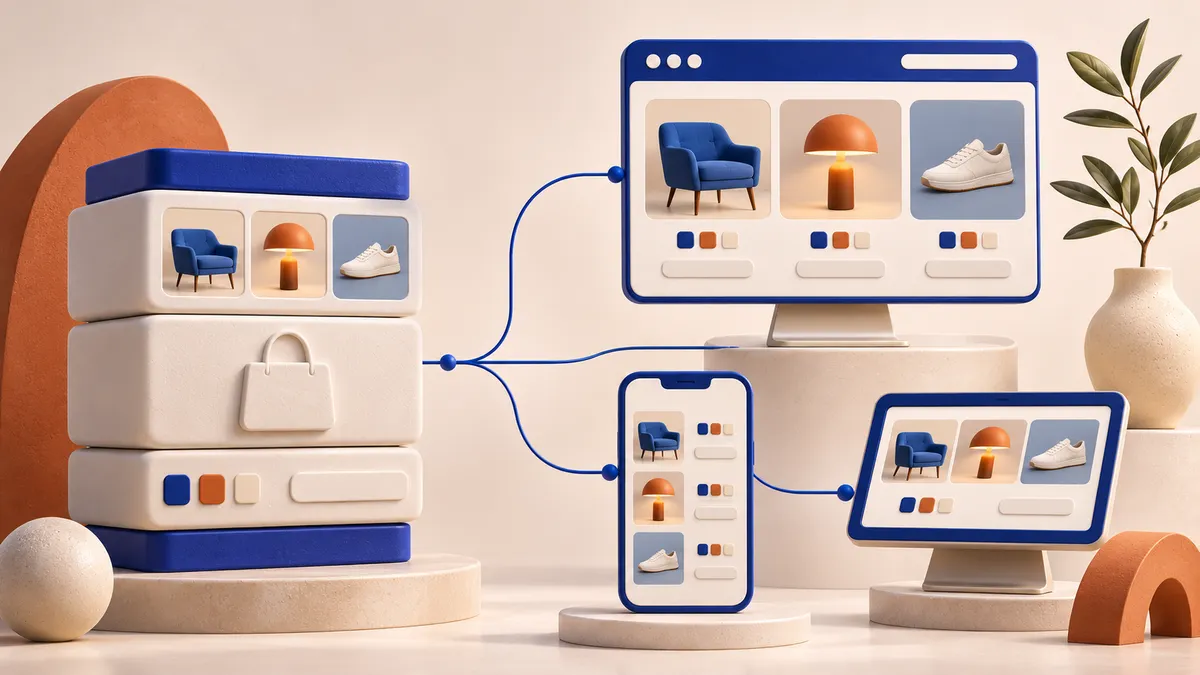
In a traditional online store, the shop the customer sees (the front-end) and the engine that manages catalog, prices, orders and payments (the back-end) are a single piece. In headless they are separate: the back-end exposes data through APIs, and the front-end, built with the framework of your choice (Next.js, Nuxt, Gatsby and similar), reads and displays it. The same back-end can power the website, an app, an in-store kiosk, a dealer portal and, increasingly, an AI assistant.
The upside is freedom on the front-end. The cost, until now, has been that the front-end must be designed, built, hosted and maintained. That is exactly the cost AI is starting to reduce.
What changed between October and November 2026
Shopify: Hydrogen becomes a library
On October 14, 2026, Shopify released Hydrogen 2026-10. Up to that version, Hydrogen was a framework based on React Router: to use its cart and analytics you had to build your entire storefront on top of it. It is now a JavaScript library that plugs into the framework you already use. It handles cart, variants, prices in the buyer's currency, Shop Pay and customer accounts.
There are ready-made starters for React Router and Next.js, it can be hosted anywhere, and Shopify's Oxygen hosting remains free. The package includes 20 "skills" for development agents and, in browsers that support WebMCP, lets an agent search the catalog and update the cart. In practice, Shopify is lowering the barrier to entry: you no longer need to rebuild your site to use its commerce components.
BigCommerce: Catalyst and native hosting
Catalyst is BigCommerce's headless storefront, built on Next.js. On April 30, 2026, the company announced native hosting for Catalyst on Cloudflare infrastructure, with an open beta planned for the summer. As of November 9, 2026, the documentation lists the Catalyst CLI as generally available, while Storefront Hosting is still in closed beta. Anyone starting with Catalyst today should plan for their own hosting or the beta.
Adobe Commerce: storefront on Edge Delivery Services
For Adobe Commerce, Adobe offers a storefront that runs on Edge Delivery Services and is assembled from "drop-ins": ready-made components, for example for cart and checkout, that you customize. It is a headless approach with many pieces already built, aimed at companies already using Adobe products.
WooCommerce and PrestaShop: the APIs exist, the rest is on you
WooCommerce offers the Store API, a public interface for cart, checkout and products, also used by its blocks. PrestaShop, according to its October 2026 Core Monthly, is working on the new Admin API. In both cases a headless front-end is possible, but there is no official storefront to start from: development falls to you or your agency.
The new variable: prompt-built storefronts and AI agents
AI changes the headless equation in three places: who builds the front-end, who uses the store, and who works in the back-end.
Who builds the front-end. With "vibe coding" you describe the page, the promotion or the whole store in plain words and an agent generates it, ready to refine. Headless freedom stays, but the upfront development cost drops. One question remains: where does the generated code live, who versions it, and who fixes it when something breaks?
Who "uses" the store. More and more purchases start from an AI assistant. To be found and bought by an agent, catalog, prices, availability and cart must be machine-readable, through APIs and protocols such as MCP (Model Context Protocol). It is the same principle as headless, applied to a customer who never sees a storefront.
Who works in the back-end. Product pages, translations, campaigns, customer support and sales analysis are tasks that specialized agents can handle under supervision. In a headless project this matters twice: the quality of the storefront depends on the quality of the data the back-end sends it.
The practical consequence: when choosing a platform today, the front-end framework matters less than how ready the back-end is for AI, both as a data source for external agents and as the place where agents do their work.
Comparison table
|
Platform |
Headless tool |
Status (Nov 12, 2026) |
Front-end hosting |
AI and agents in the headless flow |
|---|---|---|---|---|
|
Shopify |
Hydrogen (library) + Storefront API |
GA since Oct 14, 2026 |
Anywhere; Oxygen free |
20 skills for development agents; catalog search and cart via WebMCP |
|
BigCommerce |
Catalyst (Next.js) |
CLI available; native hosting in closed beta |
Self-hosted or Cloudflare beta |
Not stated in the sources cited |
|
Adobe Commerce |
Storefront on Edge Delivery Services with drop-ins |
Available |
Adobe Edge Delivery Services |
Not stated in the sources cited |
|
WooCommerce |
Store API |
Available |
Self-hosted |
Not stated in the sources cited |
|
PrestaShop |
APIs (new Admin API in progress) |
Evolving |
Self-hosted |
Not stated in the sources cited |
|
Markeplay |
Per-channel APIs + API-first CMS + JavaScript SDK; Next.js, Gatsby, Nuxt or prompt-generated front-end |
Available; API documentation and git themes being published with the new website |
Markeplay themes on git or self-hosted |
Prompt-built storefront (Ai Code and Ai Design), MCP server per store, catalog in AI assistants (Ai Bridge), team of agents in the back office |
Note: the table compares only headless and front-end-related AI offerings. Prices and plans change often and depend on volume: always check the official pages.
When headless makes sense, and when it doesn't
Gartner's 2026 report on digital commerce platforms, published October 19 and covered by BigCommerce, lists "architectural agility" and readiness for agentic AI among the priorities of companies choosing a platform. That said, headless is not a goal in itself.
It makes sense if:
- you want a highly customized front-end and have a team, an agency or an AI agent to build it;
- you need to serve several touchpoints (website, app, physical stores, dealer portal, AI assistants) from the same catalog;
- front-end performance is a business constraint and the standard theme falls short;
- you have a distinctive buying experience, for example a configurator embedded in a content site.
It doesn't make sense, or not yet, if:
- the real problem is in the catalog, price lists or orders: a new front-end, hand-written or AI-generated, won't fix it;
- nobody will maintain the front-end after launch, and the generated code doesn't live in a versioned repository;
- the store works and the standard theme covers almost everything you need.
AI lowers the barrier to entry, but maintenance remains. A useful question before deciding: what data must the front-end read, who keeps it up to date, and where does the code that displays it live?
Headless and B2B: what has to reach the front-end (and the agents)
In B2B the front-end doesn't just show products and list prices. It needs to know who the logged-in customer is and which price list applies, whether they can see prices at all, which minimum quantities apply to them, and which payment methods they can use. If this data lives in a separate plugin or an Excel sheet, the headless front-end has to rebuild it, and every duplicated rule is a point where prices can drift apart.
That is why, in B2B, the choice of back-end matters more than the choice of framework: customer price lists, rules and configurations must be exposed by the same APIs the front-end queries.
The same goes for AI agents, in two directions. An assistant buying on behalf of a buyer must read the same rules to quote the right price. And an agent generating a page or a configurator must start from the real catalog data, not a copy. A single source of truth serves the storefront, external agents and the agents working inside the back office.
Headless with Markeplay: from framework to prompt
Markeplay brings the two paths together: a headless back office that exposes catalog, price lists and orders through APIs, and AI agents that build the storefront and work on the data. You can write the front-end with the framework you prefer or describe it in words; either way it reads rules and prices from a single source.
An API-first back office
Catalog, price lists, orders, payments and content stay in the back office, and the storefront receives them through APIs. The front-end can be built with Next.js, Gatsby or Nuxt, with an API-first CMS that combines sales data and editorial content, and a JavaScript SDK that handles authentication and core operations. B2B features (price lists per customer or group, prices visible only to verified users, 24/7 self-service reordering) and the product configurator live in the same back office. Checkout can be customized too.
The prompt-built storefront: Ai Code and Ai Design
With vibe coding you describe the site, promotion or catalog page you need in plain words: Ai Code builds it, ready to refine and publish without writing code. Ai Design creates and edits the existing front-end from a prompt. The AI can generate the entire front-end from scratch, not just individual pages.
What makes the difference is where the code ends up. Markeplay themes are connected to a git repository: you can fork a theme, activate it, edit it via prompt, or connect the repository to your own editor (for example VS Code) and work on it by hand. AI generation and traditional development share the same versioned code, all the way to a 100% headless site.
Your catalog in AI assistants: Ai Bridge and MCP server
With Ai Bridge, your catalog doesn't just talk to your storefront. AI assistants such as ChatGPT, Claude and Gemini can read it too, find the right products and buy them on behalf of shoppers, even when the products are configured to measure. Every store has an MCP server to connect AI agents to catalog data, and the APIs are documented per channel, so developers can build their own integrations and agents.
A team of agents in the back office
Alongside the storefront, agents with specific skills work under the merchant's supervision:
|
Agent |
What it does |
Why it matters in a headless project |
|---|---|---|
|
Configure |
Turns rules, technical constraints and prices into guided configurators |
The front-end receives a product model that is already valid |
|
Design |
Creates and edits the front-end from a prompt |
Lowers the cost of building the storefront |
|
Code |
Builds pages, promotions and landing pages from a plain-language description |
New pages without going through an agency |
|
Catalog |
Creates and updates product pages, flags inconsistencies, suggests SEO improvements |
Complete, consistent data for every front-end |
|
Translate |
Translates product pages, pages and content |
The same headless store in more markets |
|
Search |
Interprets natural-language requests and suggests matching products |
Conversational search in the storefront |
|
Care |
Answers in chat and guides shoppers through choice and configuration |
Support inside any front-end |
|
Reach |
Prepares social content and Meta Ads campaigns, analyzes KPIs |
Marketing tied to the same catalog |
|
Insight |
Analyzes sales and performance and suggests actions |
Orders still flow through the Markeplay engine |
|
Bridge |
Brings the catalog into AI assistants |
A sales channel with no storefront |
The rule is the same for all of them: AI automates repetitive work and makes suggestions; the merchant supervises and decides. We covered this in more detail in our article on agentic B2B e-commerce [blog link: to be added].
Frequently asked questions
What is headless commerce? It is an architecture in which the store's front-end is separate from the back-end: the back-end exposes catalog, prices, cart and orders through APIs, and the front-end displays them using the chosen framework.
Is Shopify Hydrogen free? Hydrogen is an open-source library and, according to Shopify (October 14, 2026), Oxygen hosting remains free. You still need an active Shopify plan.
Does BigCommerce host the Catalyst storefront? BigCommerce has announced native hosting for Catalyst on Cloudflare. As of November 9, 2026, the documentation still lists it as closed beta.
Can you build a headless storefront with AI? Yes. With vibe coding tools you describe the page or store in words and an agent generates the code. That code should end up in a versioned repository so it can be reviewed and maintained by hand too.
What does an AI assistant need to buy from my store? Catalog, prices and cart must be accessible via APIs or protocols such as MCP. In B2B, customer price lists and rules must come from the same source.
Does headless make sense for a small or mid-sized business? It does if there is a concrete reason, such as multiple channels or a distinctive buying experience, and someone who will maintain the front-end. AI reduces development cost but does not remove maintenance. If the problem is in the catalog or price lists, fix the back-end first.
Can Markeplay be used headless? Yes: the front-end can be built with Next.js, Gatsby or Nuxt via APIs, or generated from a prompt with Ai Code and Ai Design. Themes live on git and can be edited from your own editor, every store has an MCP server, and with Ai Bridge the catalog is accessible to AI assistants.
Try the back office before choosing the front-end
Before deciding on a framework, or a prompt, find out whether the back-end can handle your price lists, rules and orders. Try it on your own catalog with the 30-day free trial: start the trial.
Already have a storefront in mind? Tell us about it in a demo: we'll describe it together to Ai Code and you'll see the result on your catalog. Book a demo.
Sources
- Shopify Developers, "Hydrogen 2026-10 is now available", Oct 14, 2026 (accessed Nov 9, 2026)
- Commerce (BigCommerce), press release "Commerce introduces new product innovations across storefronts…", Apr 30, 2026 (accessed Nov 9, 2026)
- BigCommerce Docs, Catalyst Native Hosting overview (accessed Nov 9, 2026: Storefront Hosting "closed beta")
- Adobe Experience League, Commerce Storefront, architecture and drop-ins (accessed Nov 9, 2026)
- WooCommerce Developer Docs, Store API (accessed Nov 9, 2026)
- PrestaShop Project, Core Monthly October 2026 (Admin API)
- BigCommerce blog, "2026 Gartner Magic Quadrant for Digital Commerce", Oct 29, 2026 (Gartner report dated Oct 19, 2026)